Open Console acknowledges that the traditional login process has had
its time: simply a username and password is insufficient to identify a
user. On how many websites do you need to fill-in extra details about
yourself?
With login facilities offered via the OpenID protocol, additional
facts about the user are provided to the application. However, these
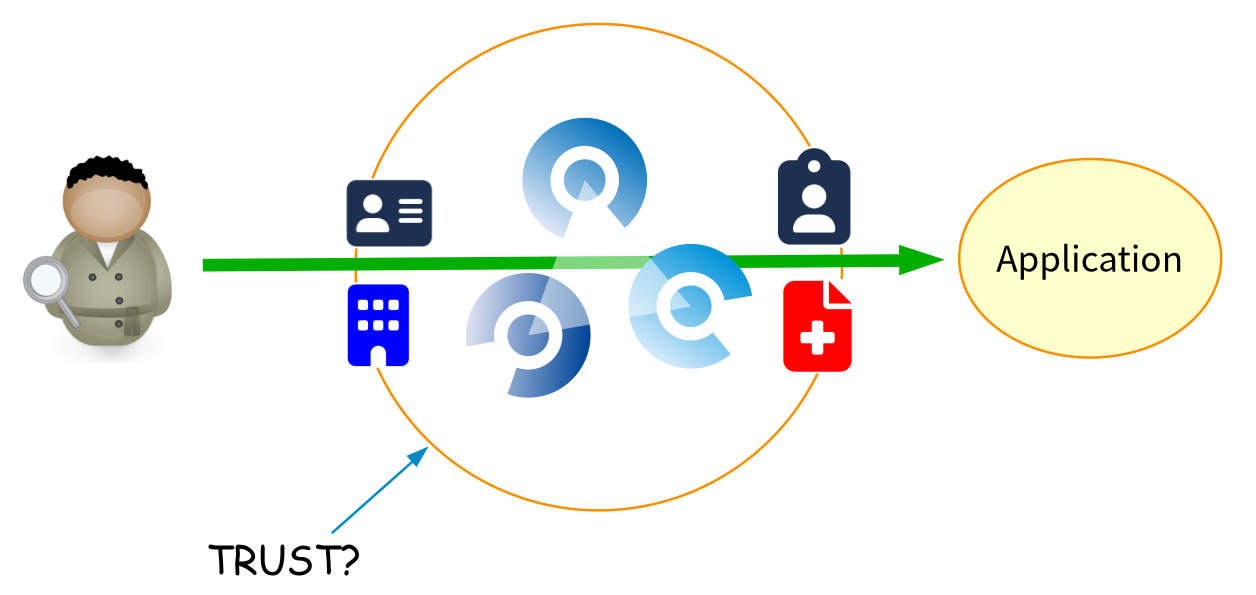
extensions are extremely basic and not transparant. Do we trust the
data which is distributed about you?
Rethink the whole login process
When we ignore minor login tweaks for now: what kinds of information
exchange do we encounter over and over again? Both the user as the
application (service) provider have needs which are not included in
the existing facilities:
Some of the needs we see and feel in our internet experiences, which
could be generalized into a better process flow:
 |
I am not flat!
- My activities are diverse: home, hobbies, work, boards,
sport, family. For different activities, I want to represent
myself differently: formal name or informal, avatar, email
address used, communition language. How can I organize this?
- Not bound to Big Tech only, I use many services which
each require me to create and account and password. My list
contains 300 registrations which I need to maintain.
- Some services require me to change the password regularly.
Safe but horrible with so many services.
|
 |
I am not alone
- At work, I need to manage application contracts with my
collegues. We do not want to register every one of them
separately at the services. When someone leaves the team, we
do not want to remove the person from all services separately
by hand.
- When we contract a service, the users are not responsible:
they should not be required to confirm the license or usage
rules.
|
 |
Transparancy adds Trust
- We wish to manage the facts which we share. I prefer a service
which only requests reasonable information from me.
- Do you trust Big Tech being involved in the login process
into a service of their competitor?
|
 |
Share more information
- Modern applications often really require more information than
a username or email address. For instance, they require a
validated phone-number, a proven website- or domainname
ownership, or a postal address to properly function.
- Many services require additional fields like "agree to the
terms". Can we generalize this?
|
Approach to improve login
Comparison to other login improvements
KeyCloak, Yivy, Solid